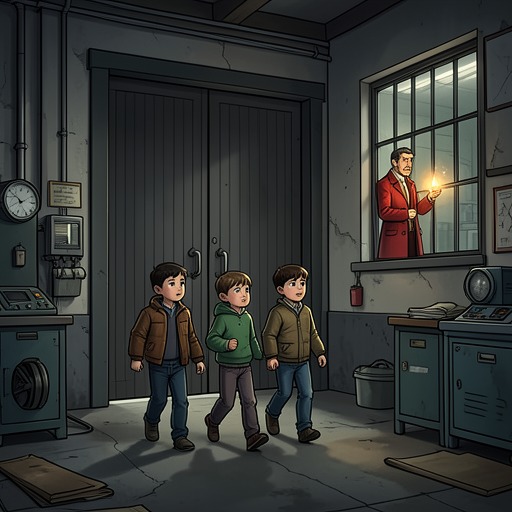
Mike Teavee is transported by television
Charlie and the Chocolate FactoryMike Teavee is transported by television in the Television-Chocolate Room after treating Willy Wonka's dangerous experiment as an opportunity for personal glory. The transmission works, but its human subject emerges drastically shrunken, so the event converts Mike's addiction to television, fascination with televised violence, and impatience with adult warnings into the most direct physical reversal of his character in the factory tour.
Identity and Preparation
Mike Teavee has already been presented as a child whose life is organized around television. When the fourth Golden Ticket is announced, he is not excited by the prize or interested in the factory's secrets. He is annoyed that reporters and visitors have interrupted his viewing. He sits before an enormous television set, watches a film in which gangsters shoot one another with machine guns, and keeps eighteen toy pistols of different sizes hanging from belts around his body. At intervals he jumps up and fires several rounds from one of the weapons, reproducing the gestures and rhythms of the violence on the screen.
His language makes the addiction especially explicit. He says that he watches television every day and watches all the programs, even the ones without shooting, while insisting that gangsters are the best because of their guns, knives, and knuckledusters. Television is therefore not merely a pastime for Mike; it is the dominant environment through which he imagines excitement, power, and the life he wants. His parents can barely control his interruptions and outbursts, while the adults around him regard his behavior as evidence of a child unable to regulate his attention.
The Television-Chocolate Experiment
Willy Wonka introduces the Television-Chocolate Room as the testing site for his latest invention, Television Chocolate. The room contains a huge black camera, Oompa-Loompas in scarlet space suits moving carefully around it, and another Oompa-Loompa watching a large television set at the opposite end. Wonka explains that his idea came from ordinary television: if a photograph can be broken into millions of pieces, sent through the air, and reassembled elsewhere, then a bar of chocolate might be transmitted in the same way.
To demonstrate the principle, Wonka places an enormous bar of chocolate before the camera. It is about the size of the mattress Charlie Bucket sleeps on at home, because anything sent by television will emerge much smaller than it was when it entered. Wonka also warns that the camera emits dangerous rays capable of breaking a person into a million tiny pieces, which is why the Oompa-Loompas wear protective space suits. The apparatus thus combines commercial promise with an openly stated physical danger: the same mechanism that can transport chocolate may also dismantle a human body.
The chocolate transmission appears successful. After a blinding flash, the bar materializes at the far end of the room in a much smaller form, and Wonka insists that it is the same chocolate, merely reduced by the journey. Grandpa Joe responds to the demonstration as a miracle. Wonka immediately imagines the commercial possibilities: someone watching television could see an advertisement for Wonka's chocolates, reach toward the screen, and take out an actual bar. The invention is presented as both technological marvel and future advertising system, linking transportation, consumption, and the power to turn a viewer's attention into an act of purchase.
Mike's Defiance and Transmission
Mike does not accept the experiment as a demonstration whose risks apply only to chocolate. When he asks whether a person could be transmitted, Wonka admits that he does not know and warns that the results might be nasty. Mike hears the uncertainty as permission. Rather than waiting for an adult decision, he runs toward the camera and announces that he will be the first person in the world to be sent by television.
Wonka repeatedly tries to stop him, and Mrs Teavee warns that he may be turned into a million tiny pieces. Mike nevertheless rushes on. At the camera he scatters the Oompa-Loompas, reaches for the switch, and leaps into the full glare of the lens while announcing his departure. His behavior mirrors the violent television performances he admires: he treats a dangerous mechanism like a stage, turns himself into the central spectacle, and acts as though daring the machine will prove his superiority.
When Mike pulls the switch, a blinding flash is followed by silence. Mrs Teavee runs forward, then stops and stares at the place where her son had been before screaming that he is gone. Mr Teavee recognizes the same terrifying absence. The scene's value changes abruptly from technological excitement to uncertainty about whether a child has survived. Wonka can offer no immediate assurance beyond the hope that Mike will emerge unharmed at the other end, while the family is forced to confront the literal danger hidden beneath the invention's entertaining surface.
Reappearance and Consequences
Wonka tells the adults to watch the television set, since Mike may come through at any moment. The screen remains blank long enough to intensify the suspense, and Mr Teavee fears that his son may be whizzing above them in a million tiny pieces. Wonka adjusts a knob; the wavy lines disappear, and the screen gradually becomes brighter. When Mike finally appears, Wonka recognizes him, but cannot yet tell whether he is all in one piece.
Mike's voice comes from the set at no louder than the squeaking of a mouse. He proudly announces that he is the first person ever to be sent by television, preserving his triumphant attitude even after the experiment has transformed him. Mrs Teavee reaches into the screen and removes him. Wonka declares him completely unharmed because the boy is physically intact, but the family sees the crucial qualification at once: Mike is no more than an inch tall. His body has survived, yet the result is still a profound injury and a visible defeat of his expectations.
Mr Teavee places the tiny boy in his jacket pocket and covers him with a handkerchief while Mike squeals, yells, and struggles like a furious prisoner. The image reverses the authority Mike sought through television. The child who wanted to command the screen has become a tiny figure confined within his father's clothing, while the device that promised limitless reach has reduced his physical presence to something that can be carried in a pocket.
Treatment and Narrative Meaning
Mrs Teavee asks how Mike can be made to grow again. Wonka admits that the problem is tricky but proposes using a special machine designed to test the stretchiness of chewing gum. His proposed remedy is consistent with the factory's logic: a bodily disaster produced by one invention will be addressed through another machine, with Mike's body treated as elastic material that might be restored by mechanical testing.
Wonka then dismisses the family's objections and summons an Oompa-Loompa by clicking his fingers three times. He gives the worker written instructions, directs him to find Mike in his father's pocket, and sends the family away with the reassurance that everything will come out in the wash. The Oompa-Loompas begin beating their drums and jogging in rhythm around the camera, preparing another song as the episode closes. Their refrain identifies the lesson in general terms: children must not be allowed to watch too much television.
The event's irony lies in the collision between Mike's fantasy and the machine's result. He wants television to make him exceptional, visible, and powerful; instead, it makes him small enough to fit in a hand. The invention does not simply punish his interest in screens through an external moral lecture. It gives that interest a material form, transporting him through the medium he cannot stop watching and returning him as a diminished version of himself. Television is shown simultaneously as a technological possibility, a commercial channel, a source of passive absorption, and a danger when its user mistakes spectacle for control.
Mike's transmission also completes the contrast established by his earlier Golden Ticket appearance. The worldwide ticket hunt turns attention into mass consumption, and the factory tour turns each child's dominant habit into a test. In Mike's case, the object of obsession becomes the mechanism of consequence. His survival keeps the scene within the factory's comic and corrective pattern, but his reduction to an inch tall makes the correction unmistakably physical: the child who wanted to enter television is allowed to do so only by surrendering the bodily scale and authority he took for granted.